
The Advantage system was introduced in 2022 for competitive handicap Golf Croquet matches. It aims to allow players of different abilities to play with each having an equal chance of winning. The approach is changing for 2026, as described below.
Under the previous approach, the starting scores would be adjusted for players of different handicap, often meaning the stronger player started with a negative score and needed to run more than 7 hoops to win a “First to 7” game.
Under the new approach, a game always starts from 0:0 but players with different handicaps will have different “Target Scores”. Target Scores replace Starting Scores for ALL Advantage play in England from March 1 2026. This includes external matches in the Croquet South-East Handicap League and the following internal competitions at RTWCC:
Under the previous approach, the starting scores would be adjusted for players of different handicap, often meaning the stronger player started with a negative score and needed to run more than 7 hoops to win a “First to 7” game.
Under the new approach, a game always starts from 0:0 but players with different handicaps will have different “Target Scores”. Target Scores replace Starting Scores for ALL Advantage play in England from March 1 2026. This includes external matches in the Croquet South-East Handicap League and the following internal competitions at RTWCC:
• Kitching Rose Bowl
• Golf Doubles
• Golf High Bisquers and
• Fraser Tankard (Tuesday evening league).
• Golf Doubles
• Golf High Bisquers and
• Fraser Tankard (Tuesday evening league).
One consequence of the change is that normal-length matches can no longer be considered “First to 7”; instead they are now called “Standard” games. (The two main variants were “First to 4” and “First to 10”; these are now called “Short” and “Long” games, respectively.)
A grid of Target Scores for Standard games is pinned on the noticeboard in the clubhouse,and can be downloaded by clicking on the image below
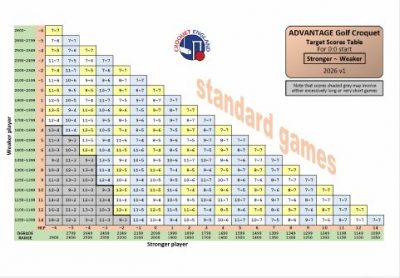
An example may help to illustrate the use of Target Scores: if Trevor (with a handicap of 3) plays Dave (with a handicap of 9), then the Target Scores would be 11:7, so Trevor would need to run 11 hoops before Dave runs 7.
We have purchased new counters that support the new approach, illustrated below, where Trevor won the toss, so is “Player 1”:
We have purchased new counters that support the new approach, illustrated below, where Trevor won the toss, so is “Player 1”:
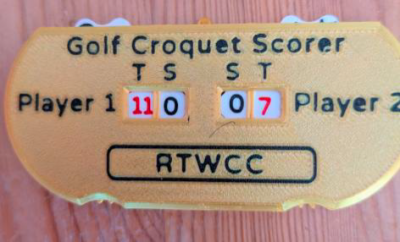
The counter is operated as follows:
1. Look up the Target Scores on the grid
2. Toss, to determine who is starting the game (and hence is “Player 1”)
3. Press the button at the top AND turn the cogs at the bottom to set the Target Scores (“T”)
4. Turn the cogs at the top to set the current scores (“S”) to zero.
5. After running a hoop, turn the appropriate cog at the top to update the current scores
6. We encourage the player with the lower handicap to regularly update their opponent on scores AND the Target Scores during a game
7. The counters should be returned at the end of a game, not taken away from the club.
Notes:
• Unfortunately, the Target Scores on the new counters start at 5, but there are Target Scores of 4 in the grid – we have raised this with the manufacturer. In the meantime, members could set the relevant Target Score to 5, but remember that it should be 4.
•. The second grid on the noticeboard that shows “Scoring Fraction Percentages” is only relevant for unfinished games (i.e. where a time limit has been specified ahead of a game). Again an example may help:
If Trevor (with a Target Score of 11) has run 8 hoops, then his Scoring Fraction Percentage is 73%;
If Dave (with a Target Score of 7) has run 5 hoops, then his Scoring Fraction Percentage is 71%;
Then Trevor wins (as usual ) because he has the higher Scoring Fraction Percentage
If Dave (with a Target Score of 7) has run 5 hoops, then his Scoring Fraction Percentage is 71%;
Then Trevor wins (as usual ) because he has the higher Scoring Fraction Percentage
•. The cylindrical counters are still on the counter, as these can be used for Level play matches.
Finally, a reminder that members:
1. Need to keep their handicap cards up-to-date, recording the results of singles matches played in the club’s competitions, matches against other clubs and external competitions. (The exception is the “Winter Challenge”, where jumping is not allowed, so these games do not count for handicap purposes.) and
2. Let a club handicapper (Trevor Houghton-Berry and Dave Grimshaw) know if you pass through a trigger point, so that they can validate the change in your handicap.
If you have any questions on Target Scores, or GC handicapping more generally, please contact Dave Grimshaw by email at dlgrimshaw@hotmail.com
1. Need to keep their handicap cards up-to-date, recording the results of singles matches played in the club’s competitions, matches against other clubs and external competitions. (The exception is the “Winter Challenge”, where jumping is not allowed, so these games do not count for handicap purposes.) and
2. Let a club handicapper (Trevor Houghton-Berry and Dave Grimshaw) know if you pass through a trigger point, so that they can validate the change in your handicap.
If you have any questions on Target Scores, or GC handicapping more generally, please contact Dave Grimshaw by email at dlgrimshaw@hotmail.com